
If you’ve been learning French for a while without a clear sense of progress, the problem probably isn’t effort. It’s direction. Most self-learners pile up hours with flashcard apps, YouTube videos, and the occasional grammar workbook, but without knowing what actually matters at their current level, that effort scatters instead of compounds.
This guide lays out a level-by-level roadmap: what to prioritize at each CEFR stage, roughly how many hours that stage tends to require, the plateaus to expect, and which study methods hold up under scrutiny. It draws on published benchmarks from the U.S. Foreign Service Institute and Cambridge English, along with research on how memory actually retains language.
Key Takeaways
- Reaching a solid intermediate level (Cambridge’s B1-B2 band) typically takes several hundred cumulative study hours, not a few weeks of casual practice.
- Beginners get more value from pronunciation and high-frequency vocabulary than from chasing grammatical completeness.
- The climb from B1 to B2 is the steepest stretch of the entire journey, according to Cambridge English’s guided-learning-hour benchmarks.
- Spaced repetition and steady exposure to real French, not any single app, are what the research shows actually builds lasting retention.
- French is now the world’s fourth most-spoken language, with growth increasingly centered in Africa rather than Europe.
How Long Does It Actually Take to Learn French?
Plan on several hundred hours of real study before French starts to feel comfortable, and closer to a thousand hours or more before it feels close to effortless. The exact number depends on which benchmark you use and how intensively you study, but every serious estimate lands in the same general territory: this is a months-to-years project, not a weeks project.
The most widely cited figure comes from the U.S. Department of State’s Foreign Service Institute. It’s commonly reported to classify French as a Category I language, the easiest tier for native English speakers (Foreign Service Institute). Reaching General Professional Proficiency at that level takes roughly 600 to 750 class hours, or about 24 to 30 weeks. That figure deserves a caveat: it describes full-time, in-person immersion at around 25 classroom hours a week, plus homework, for career diplomats. Almost no self-learner studies at that pace. Treat the number as a ceiling on how fast French can be learned under ideal conditions, not a benchmark for evening study sessions.
A more granular, self-study-friendly reference comes from Cambridge English. Its guided-learning-hour benchmarks estimate cumulative hours needed from zero to reach each CEFR level (Cambridge English):
| CEFR Level | Cumulative Hours From Zero |
|---|---|
| A2 | 180-200 |
| B1 | 350-400 |
| B2 | 500-600 |
| C1 | 700-800 |
| C2 | 1,000-1,200 |
These are exam-board planning benchmarks commonly aligned to CEFR levels, not figures published by the Council of Europe itself. Actual hours vary by learner, materials, and how much of that time is genuine practice versus passive review.
Used practically, these numbers convert into a study plan. At five focused hours a week, reaching Cambridge’s roughly 550-hour B2 benchmark takes a little over two years. Doubling that pace to ten hours a week cuts the timeline to about a year. Neither pace is wrong: the math simply shows why casual, sporadic study rarely produces visible progress. Fifteen minutes a day adds up to under two hours a week, nowhere close to what any benchmark assumes.
Beginner Stage (A1-A2): What to Focus On
At A1-A2, the highest-value work is pronunciation and high-frequency vocabulary, not grammatical completeness. Beginners often over-invest in memorizing verb tables they won’t use for months and under-invest in the sounds and words they’ll need every single day. Fix that imbalance first.
Pronunciation Before Anything Else
French pronunciation habits set in early and are hard to unlearn later, so this is the one area where beginners benefit from disproportionate attention. Nasal vowels, the uvular French R, and liaison (linking word-final and word-initial sounds) don’t appear in English and need deliberate, repeated listening and imitation. Shadowing, speaking along with audio a beat behind the speaker, is one of the more efficient ways to internalize these sounds without a live tutor.
Core Grammar That Actually Gets Used
At this stage, prioritize the present tense of common regular and irregular verbs, noun gender (le/la, un/une), and basic sentence structure (subject-verb-object, negation with ne…pas). Skip the subjunctive, the passé simple, and rare irregular conjugations entirely for now. They contribute little to comprehension at A1-A2 and can wait for the intermediate stage.
Vocabulary: Frequency Over Breadth
A vocabulary list of the 1,000-2,000 most frequent French words covers the overwhelming majority of everyday conversation. Learning obscure or topic-specific words before mastering these high-frequency building blocks is a common beginner mistake. It feels productive but delivers little practical payoff. Master French Online’s word lists are organized by topic if you want to build frequency-first vocabulary systematically.
Listening to Material Built for Your Level
Native-speed French radio or films will mostly wash over an A1-A2 learner as noise. Graded audio, podcasts and courses recorded specifically for learners at a slower pace with controlled vocabulary, builds listening comprehension without the discouragement of understanding almost nothing. Master French Online’s French podcast is built for exactly this kind of graded listening practice.
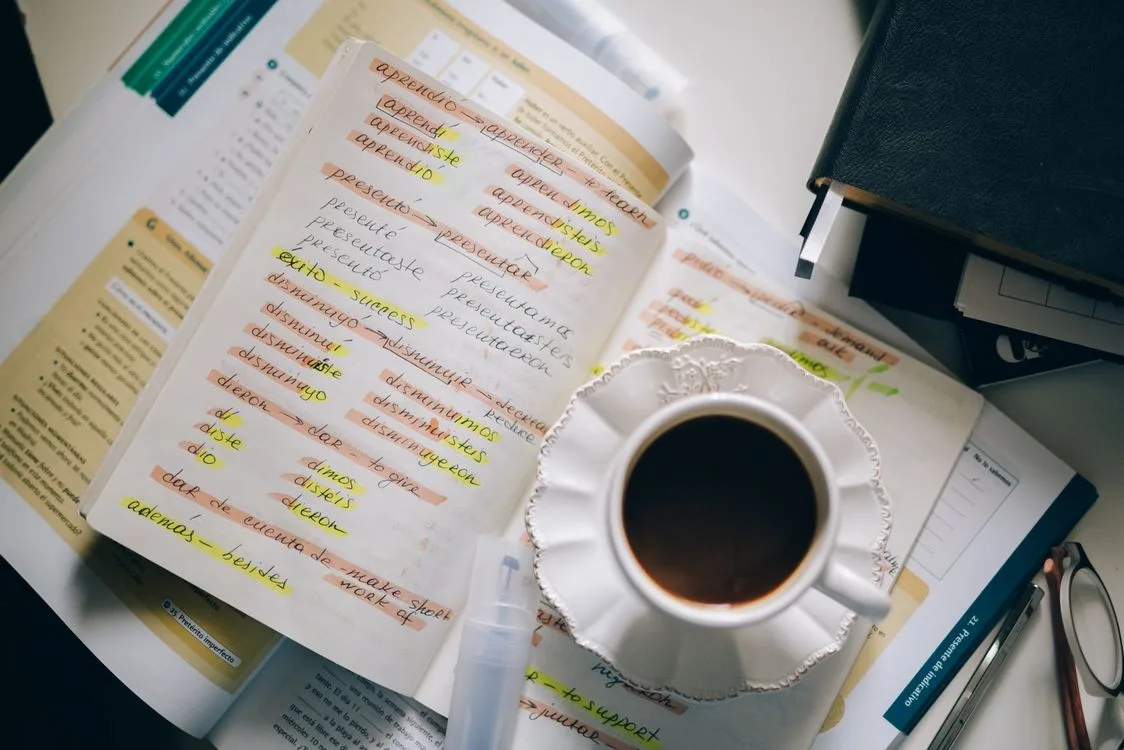
A common beginner pitfall is treating an app streak as proof of progress. Finishing lessons in a gamified app can create a feeling of momentum without necessarily building active recall or listening comprehension. Pair any app-based study with real audio input and, ideally, some spoken output from the start.
Intermediate Stage (B1-B2): Breaking Through the Plateau
The stretch from B1 to B2 is where most self-learners stall, and Cambridge English’s own guidance on guided learning hours explains why: the jump from B1 to B2 requires more cumulative hours than the entire journey from A1 through B1 combined (Cambridge English). This is the classic intermediate plateau: you can hold a basic conversation, but nuance, speed, and idiomatic phrasing still feel out of reach, and progress that once felt fast starts to feel slow.
Why the Plateau Happens
At B1, a learner can succeed with a relatively small toolkit: a core set of verbs, present and near-past tenses, and a few hundred frequent words. B2 demands something qualitatively different: following native-speed conversation, expressing opinions with nuance, and handling unpredictable topics. That’s a jump in kind, not just in vocabulary size, which is part of why it takes disproportionately longer.
Grammar That Unlocks B2
This is where the compound past (passé composé) and imperfect (imparfait) need to become automatic, since together they carry most everyday narration. It’s also the point to start recognizing, though not yet fully mastering, the subjunctive mood, which appears constantly in spoken French after expressions of doubt, emotion, and necessity.
Immersion and Conversation Practice
Passive study stalls here more than at any other stage. Regular conversation practice, whether with a language exchange partner, a tutor, or a conversation group, forces the real-time retrieval that reading and flashcards don’t. Watching French shows with French subtitles (not translated ones) and listening to native podcasts on familiar topics both push comprehension toward native speed. Reading Master French Online’s French dialogues out loud is a low-pressure way to rehearse natural phrasing before attempting live conversation.

Pronunciation habits picked up loosely at the beginner stage are worth revisiting here, since intermediate learners are finally producing enough spontaneous speech for old habits to show up clearly.
![Video thumbnail for Master French pronunciation rules in 10 minutes [Easy Guide]](https://img.youtube.com/vi/YC23ulrY5Ms/hqdefault.jpg)
Common Mistake at This Stage
Many intermediate learners keep adding new material (new apps, new textbooks, new vocabulary lists) instead of consolidating what they already half-know. At B1-B2, revisiting and actively using existing vocabulary in speech and writing usually produces more visible gains than any new resource.
Advanced Stage (C1-C2): Achieving Fluency and Nuance
At C1-C2, the work shifts from learning new grammar to sharpening judgment: choosing the right register, catching idiom and cultural reference, and writing with the precision of an educated native speaker. Cambridge English’s benchmarks place this stage at roughly 700-1,200 cumulative hours from zero (Cambridge English), and most of that time at the top end goes toward refinement rather than acquisition of new basic structures.
Register and Nuance
Advanced learners need to recognize and switch between registers: the difference between how a French colleague emails a client, texts a friend, and speaks in a formal meeting. These shifts involve vocabulary choice, verb mood, and even sentence length, and native media is the best teacher here because textbooks rarely model informal registers accurately.
Native Media as Primary Input
At this stage, French news, films, novels, and podcasts intended for native speakers, not learners, should make up the bulk of listening and reading practice. Struggling occasionally with an unfamiliar reference or idiom is expected and useful. It’s the signal that tells you what to look up next.
Formal Writing
Writing a structured argument, an email, or a short essay in French and having it corrected, by a tutor, an exchange partner, or a careful self-review against a style guide, does more for advanced fluency than additional passive reading. Formal written French follows conventions in word order, connector words, and register that spoken French often skips.
Common Mistake at This Stage
Advanced learners sometimes stop tracking progress altogether because gains become harder to measure day to day. Setting concrete, occasional benchmarks, reading a novel without a dictionary, understanding a fast native podcast at full speed, holding a debate on a complex topic, keeps the C1-C2 stage from feeling directionless.
Methods and Resources That Work at Every Level
Spaced repetition, comprehensible input, and structured conversation practice hold up at every stage of learning French, while any single app or program works best as a supplement, not a complete plan.
Spaced Repetition
Reviewing vocabulary at increasing intervals, rather than cramming it in one sitting, is one of the more rigorously tested findings in learning research. A large meta-analysis covering 839 assessments across 317 experiments in 184 studies found that distributed practice consistently outperforms massed practice for verbal recall tasks (Cepeda, Pashler, Vul, Wixted & Rohrer, 2006, Psychological Bulletin). Flashcard apps that schedule reviews automatically (Anki is the best-known example) apply this finding directly, but the underlying principle, spacing reviews out instead of bunching them, matters more than which specific tool you use.
Comprehensible Input
Listening to and reading material that’s just above your current level, understandable with effort but not word-for-word, builds vocabulary and grammar intuition in a way that explicit rule memorization doesn’t fully replace. This is the theoretical backbone behind graded readers and slow-French podcasts, and it works alongside explicit grammar study rather than instead of it.
Structured Programs and In-Person Immersion
For learners who want a formal support structure, the Alliance Française network remains one of the largest in the world for French instruction outside France.
In numbers: The Fondation des Alliances Françaises reports 824 centers across 138 countries, serving roughly 428,000 learners as of 2024 (Fondation des Alliances Françaises).
That scale means most learners, regardless of location, can find some form of in-person class, cultural event, or exam center nearby, which matters for the conversation practice that self-study alone struggles to replicate.
Apps and Self-Study Platforms
Apps are a reasonable entry point and a useful daily habit-builder, but they should be understood for what the data actually shows: platform popularity, not proof of learning outcomes. Duolingo’s own 2025 Language Report ranks French as the third most-studied language on its platform globally. It also notes French is the most common “second-place” language learners study in 60 countries, more than Spanish (48 countries) or German (22 countries) (Duolingo Language Report 2025). That reflects Duolingo’s own user base and course-completion patterns, not an independent measure of how many people worldwide are learning French or how well they’re learning it.
Why French Is Worth the Investment
French is currently the world’s fourth most-spoken language, with roughly 396 million speakers worldwide, trailing only English, Mandarin, and Spanish (Organisation internationale de la Francophonie, via the French Ministry for Europe and Foreign Affairs, 2026), and its future growth is increasingly centered in Africa rather than Europe.
According to that same source, about 65% of French speakers currently live in Africa, and that share is projected to reach roughly 90% by 2050 as the continent’s population continues to grow. That shift matters practically for learners: the French spoken in Dakar, Abidjan, and Kinshasa is shaping the language’s future at least as much as the French spoken in Paris.
French also remains one of the more geographically distributed official languages in the world, holding official status in nearly 30 countries of the Francophonie across Europe, Africa, North America, and the Pacific. For a self-learner, that breadth translates into a wide range of destinations, media, and communities to practice with, well beyond a single country’s borders.
Frequently Asked Questions
How many hours a day should I study French?
Consistency matters more than any specific daily number. Thirty to sixty minutes of focused daily study, combining active practice such as speaking, writing, and flashcard review with passive listening, sustains progress better than occasional multi-hour sessions. Using Cambridge English’s cumulative hour benchmarks, roughly 45 minutes a day (about 5-6 hours a week) puts B2 within reach in a little over two years; more daily time compresses that timeline.
Can I become fluent without living in France?
Yes. Immersion helps, but it isn’t a requirement. Consistent exposure to native-level French media, regular speaking practice with tutors or exchange partners, and structured study can bring a self-learner to a high level without relocating. The Alliance Française network and online exchange platforms make it possible to simulate much of what in-country immersion provides.
Is French harder than Spanish?
For native English speakers, both are grouped in the same easiest tier by the U.S. Foreign Service Institute, so neither is dramatically harder on paper. In practice, French pronunciation and its many silent letters tend to challenge English speakers more early on, while Spanish’s more consistent spelling-to-sound relationship gives it a smoother start. French’s grammar and verb system are broadly comparable in difficulty to Spanish’s.
What CEFR level counts as fluent?
There’s no single official cutoff, but B2 is commonly treated as the threshold for functional, independent fluency, comfortable handling most everyday, academic, and professional situations without constant reliance on a dictionary. C1-C2 represent a further step toward native-like nuance and precision rather than a different kind of fluency altogether.
Conclusion
The single biggest lesson across every stage is that progress in French follows the hours you put in and where you point them, not the number of apps you’ve downloaded. Beginners get the most from pronunciation and high-frequency vocabulary, intermediate learners need to push through the B1-B2 plateau with real conversation and consolidation rather than new resources, and advanced learners refine nuance through native media and formal writing. None of the benchmarks in this guide are guarantees. They’re planning tools, useful for setting realistic expectations rather than measuring yourself against someone else’s timeline.
If you’re ready to put a plan behind these priorities, explore Master French Online‘s word lists, dialogues, and podcast to match practice material to your current stage.
Master French Online publishes practical, research-backed guides for self-directed French learners, drawing on published benchmarks from institutions like the Foreign Service Institute and Cambridge English rather than anecdote. Every statistic in this guide links to its original source so you can verify it yourself.
Leave a Reply